AI for Space Weather: Forecasting Geomagnetic Risks on Power Grids 30–60 Minutes in Advance
微軟研發太空天氣預報 AI:結合地質與物理,提早 30-60 分鐘預警全美電網地磁暴風險
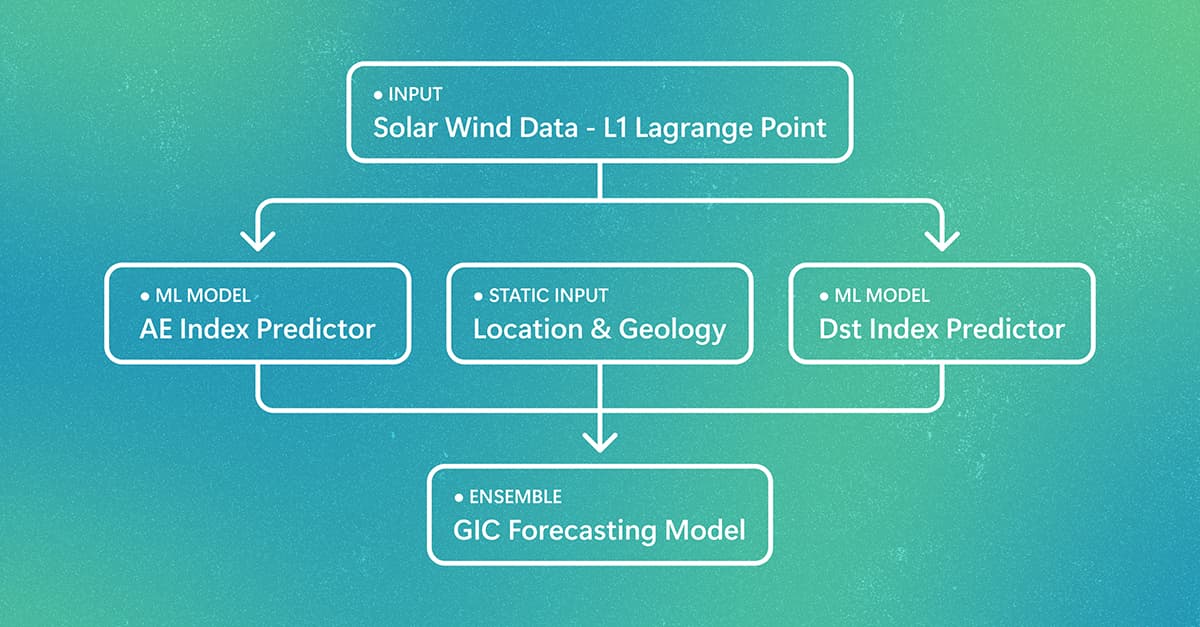
Microsoft Research developed an ML pipeline that utilizes solar-wind data from the L1 Lagrange point to forecast geomagnetic indices (AE and Dst). Combined with substation-specific geology and latitude data, a gradient-boosting model predicts the magnetic-field change rate (dB/dt). The system detected nearly 80% of major space-weather events and completed inference for 66,935 US substations in 333 milliseconds, providing grid operators with a critical 30-to-60-minute early warning.
Key points
End-to-End Pipeline
Transforms raw solar-wind measurements from the L1 Lagrange point into indices, mapping directly to substation-level geomagnetic rate of change.
Physics and Geology Integrated
Factors in how local resistive bedrock amplifies geomagnetically induced currents (GICs), tailoring risk by latitude and geology.
30–60 Minutes Warning
Achieved a 76.5% detection rate for major events, giving grid operators actionable lead time to adjust reactive-power reserves.
AI Agent Collaborative Design
A multi-agent team of 50 AI agents assisted researchers in feature exploration, validation strategies, and model tuning.
How it works
Why it matters
Extreme space weather causes geomagnetically induced currents (GICs) that can damage grid infrastructure. Rather than relying on broad, regional alerts, this pipeline delivers fast, substation-level forecasts. A 30–60 minute localized lead time allows utilities to prioritize targeted engineering reviews and preemptively adjust reactive-power reserves without disrupting the entire grid.
Who it affects
- AI Researcher
- Enterprise Leader
- Product Manager
- AI Developer
How to use it
- 1Grid Operational Defense: Power operators reconfiguring transmission topologies to mitigate GIC impact before a storm hits.
- 2Infrastructure Resilience Planning: Prioritizing physical reinforcement and transformer upgrades based on simulated geoelectric hazards.
Limitations & caveats
- The system requires further validation with utility operators and real-world operational data before live deployment.
- The current forecast window is limited to 30-60 minutes; extending this requires exploring temporal-transformer architectures.
Related
Ai2 Open-Sources AstaBrief: An 8B Scientific Report Generator 3.5x Faster than Claude
艾倫人工智慧研究所開源 AstaBrief:比 Claude 快 3.5 倍的 8B 科學報告生成模型
Allen Institute for AI (Ai2) has open-sourced AstaBrief 8B, a specialized model for scientific report generation that achieves a 3.5x speedup over proprietary pipelines while maintaining high citation accuracy.
GALA: Distilling 3D Gaussian Avatars into Linear Blendshapes for Real-Time Animation
GALA:用線性混合變形蒸餾技術實現 3D Gaussian 虛擬化身即時動畫
GALA distills complex neural decoding of 3D Gaussian avatars into lightweight linear blendshapes, reducing CPU animation costs by up to 1000x and enabling 60fps real-time performance on mobile devices.
ScholarCatalyst: A Benchmark for Testing AI's Intuition in Retrieving Inspiring Research Papers
ScholarCatalyst:評估 AI 是否擁有「科學家直覺」的學術文獻檢索基準
ScholarCatalyst is a novel benchmark featuring annotations from 184 lead authors to evaluate whether AI can retrieve key inspiring papers from past literature based only on an initial research question.