Accelerating Robotics Simulation and Physical AI Learning with NVIDIA Warp and MJWarp
利用 NVIDIA Warp 與 MJWarp 加速機器人模擬與物理 AI 強化學習
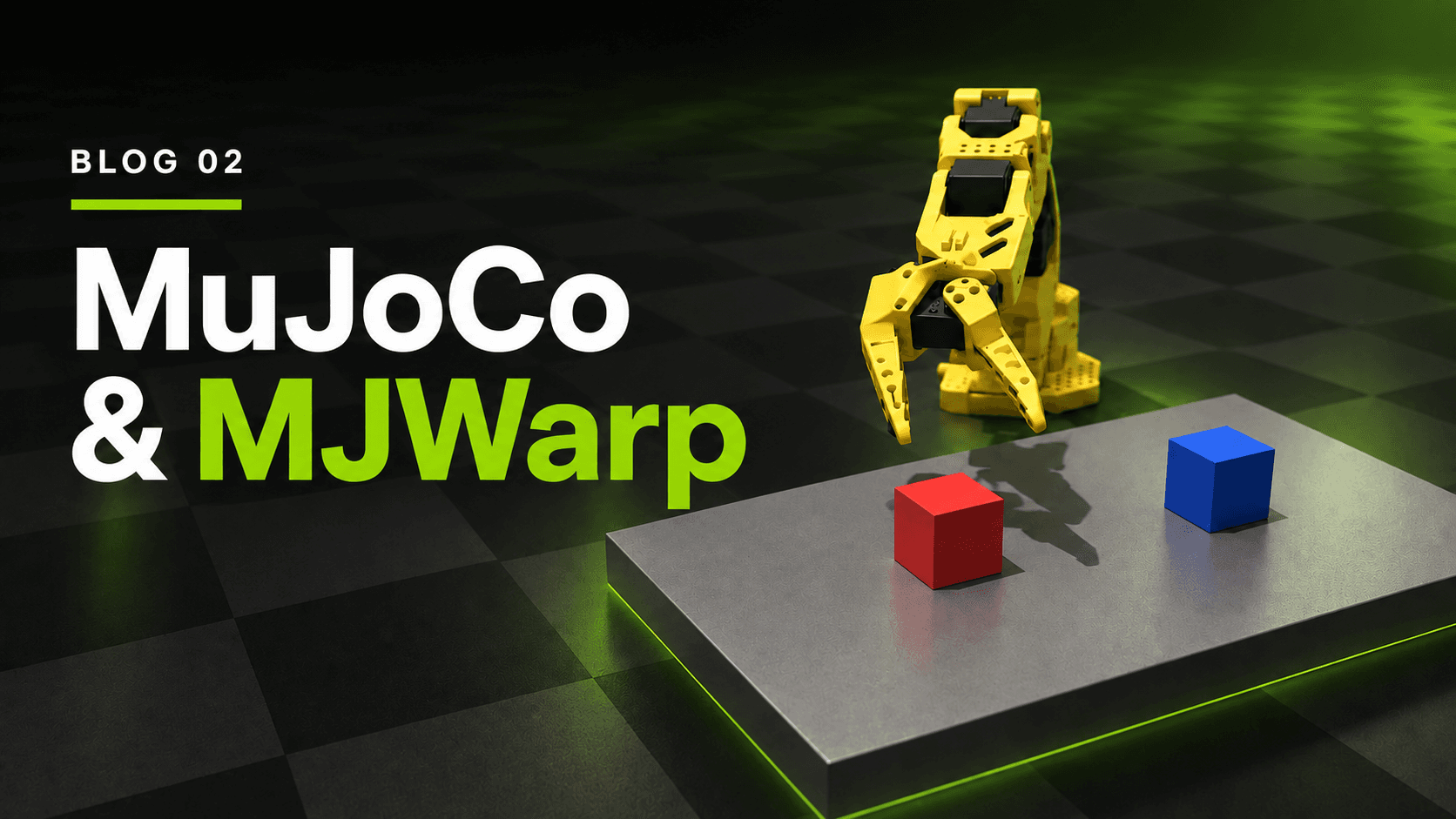
Robotics RL requires massive simulation datasets. NVIDIA Warp compiles Python kernels directly to GPU/CUDA, and MJWarp re-implements MuJoCo physics on Warp. Using an SO-101 manipulator task, this tutorial demonstrates migrating from CPU-based MuJoCo to 2,048+ parallel GPU environments. By leveraging CUDA Graph capture to bypass Python dispatch bottlenecks, MJWarp achieves massive aggregate throughput (world-steps/second).
Key points
Throughput-Oriented Architecture
MJWarp focuses on advancing thousands of parallel worlds simultaneously. It prioritizes total world-steps completed per second (throughput) over minimizing single-world latency, making it ideal for RL and sampling.
Simple API Migration
Transitioning is straightforward: load standard MJCF files, upload the model and data structs to the GPU via `mjw.put_model()` and `mjw.make_data()`, and advance all worlds with `mjw.step()`.
CUDA Graph Optimization
Using `wp.ScopedCapture()` to capture the multiple GPU kernels of `mjw.step` into a reusable CUDA Graph eliminates Python dispatch overhead between steps.
Strict Contact Budgeting
Constraint and contact buffers (like `nconmax` and `njmax`) must be pre-allocated on the GPU. Size them against the most contact-heavy moments of the task to avoid silent overflows.
How it works
Why it matters
CPU bottlenecks in traditional simulators hamper the data generation needed for Physical AI training. By hosting MuJoCo's physics engine entirely on GPU and supporting DLPack-style zero-copy interop with PyTorch and JAX, MJWarp enables GPU-resident learning loops. This slashes Sim-to-Real development cycles and accelerates the creation of robots capable of complex real-world interaction.
Who it affects
- AI Developer
- AI Researcher
- Enterprise Leader
How to use it
- 1Reinforcement learning training for robotic manipulators (e.g. SO-101) across thousands of parallel environments.
- 2Parallel trajectory sampling and optimization for predictive control (Sampling-based MPC) at scale.
Limitations & caveats
- Single-world simulation latency is not optimized, making it unsuitable for real-time single-robot teleoperation.
- Constraint and contact buffer allocations must be manually tuned; underestimating these values leads to overflow errors and invalid trajectories.
Related
AD-WM: Action-Discriminative World Models for Counterfactual MPC
AD-WM:專為反事實預測控制設計的動作辨識世界模型
AD-WM enhances latent world models by learning to distinguish alternative actions from the same state, significantly improving counterfactual control and zero-shot transfer in robotics.
RAPID: Robot Agentic Programming from Demonstrations
RAPID:只需單次視覺示範,AI 代理即可自動生成與優化機器人操控程式
RAPID is a framework that automatically infers task specifications and environments from a single visual demonstration, using an agentic loop to program and refine generalized robot skills.
Rolling-WAM: Accelerating Robotic World Action Models via Rolling Imagination
Rolling-WAM:利用滾動想像實現高效控制的機器人世界動作模型
Rolling-WAM accelerates world action models by distributing the joint video-action denoising process across sliding windows over successive replanning cycles, achieving a 4.5x speedup.