Minimally Invasive Steering of LMs: Optimizing Rewards Without Quality Degradation
微創型語言模型導向技術:利用 MISVO 在不損害生成品質下優化輸出
Standard pre-logit steering adds vectors to final hidden states to align frozen LLMs with test-time rewards, but unregularized optimization often degrades generation quality. To solve this, researchers developed MISVO (Minimally Invasive Steering Vector Optimization). By penalizing interventions using the local KL geometry of the token distribution, MISVO computes analytic gradients without parameter tuning. Tested on 1B–14B parameter models for preference and code generation, MISVO achieved the highest mean reward in 6 out of 7 settings while preserving Best-of-N level diversity and coherence.
Key points
Preventing Unregularized Quality Degradation
Traditional pre-logit steering heavily distorts output distributions. MISVO limits intervention magnitude, ensuring high-quality generation while pursuing rewards.
Fisher Quadratic Regularization
It leverages the local KL geometry (Fisher information) to measure distributional sensitivity, providing a precise, non-invasive penalty for steering.
Parameter-Free, Analytic Gradients
By computing analytic gradients via matrix-vector products with the frozen LM head, it optimizes position-specific interventions without updating parameters.
Strong Empirical Performance
Across 1B to 14B parameter models, MISVO achieved the highest mean reward in 6 of 7 settings while maintaining competitive generation coherence.
How it works
Why it matters
As the demand for steering and aligning LLMs grows, traditional fine-tuning remains expensive and prone to catastrophic forgetting. MISVO offers a 'minimally invasive' test-time control method. It completely avoids parameter updates while solving the coherence-degradation issue inherent in previous vector steering methods, paving the way for efficient, controllable, and cost-effective LLM deployment.
Who it affects
- AI Developer
- AI Researcher
- Product Manager
How to use it
- 1Real-time alignment: Steering model outputs based on safety, style, or specific preferences at inference time without retraining.
- 2Controlled code generation: Optimizing code generation models to meet specific constraints or rewards while preserving syntactic correctness.
Limitations & caveats
- The mathematical derivation assumes a fixed generation horizon, which may not generalize perfectly to highly dynamic or infinite-length generation tasks.
- The steering effectiveness heavily relies on the quality and accuracy of the test-time reward model.
Related

Accelerating MoE Training for Biological Foundation Models with NVIDIA Transformer Engine
NVIDIA Transformer Engine 加速生物基礎模型 MoE 訓練:吞吐量提升達 2.21 倍
This guide demonstrates how to use NVIDIA BioNeMo and Transformer Engine's optimized primitives to overcome MoE training bottlenecks in biological models, boosting throughput by up to 2.21x.
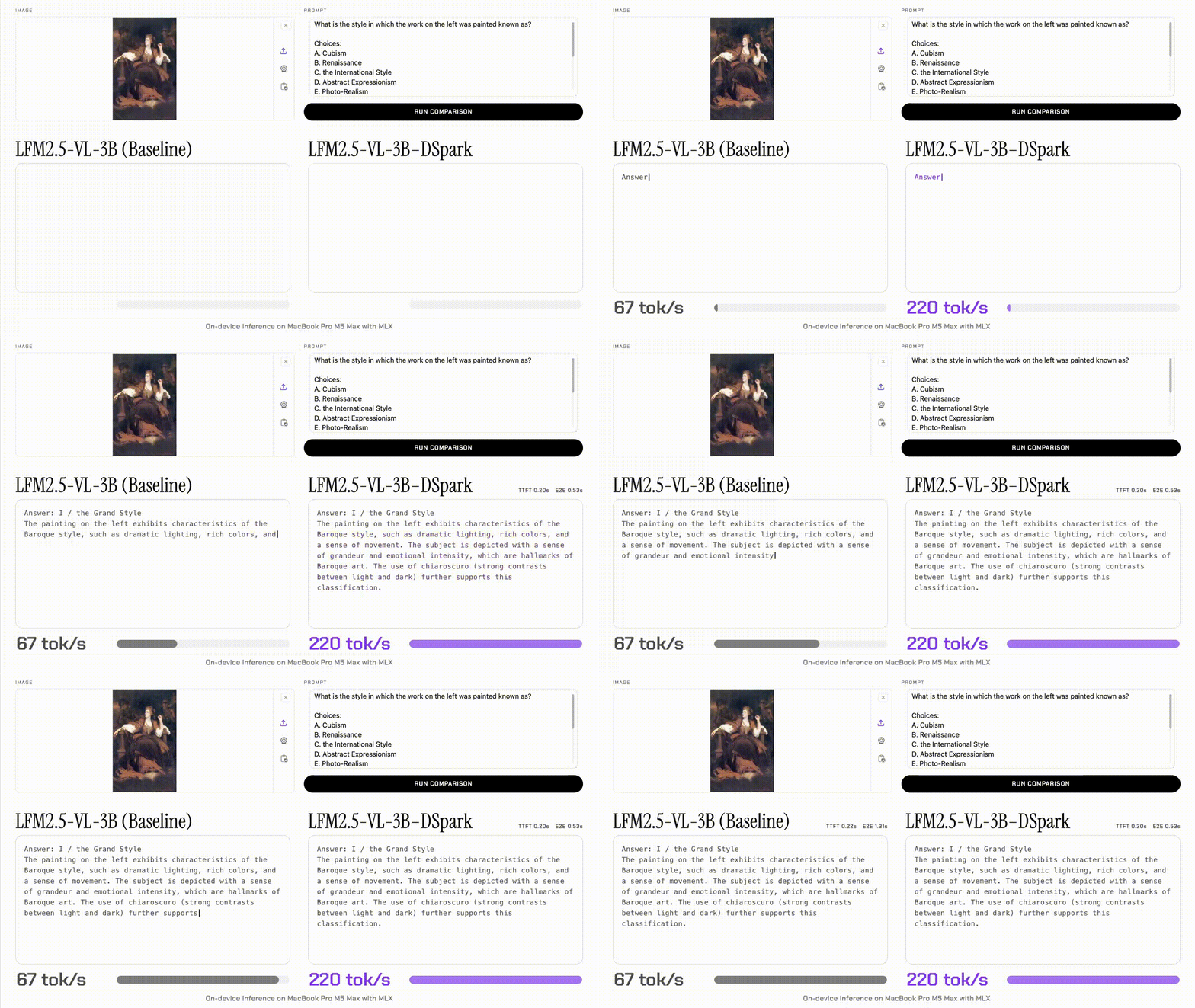
LFM2.5-VL-DSpark: Accelerating Vision-Language Models with Minimal Overhead
LFM2.5-VL-DSpark:以超低開銷將多模態模型推論速度提升達 3 倍
Liquid AI has released a 280M parameter DSpark draft model for LFM2.5-VL-3B, boosting decoding speeds up to 3.13 on-device with only 8.9% parameter overhead.
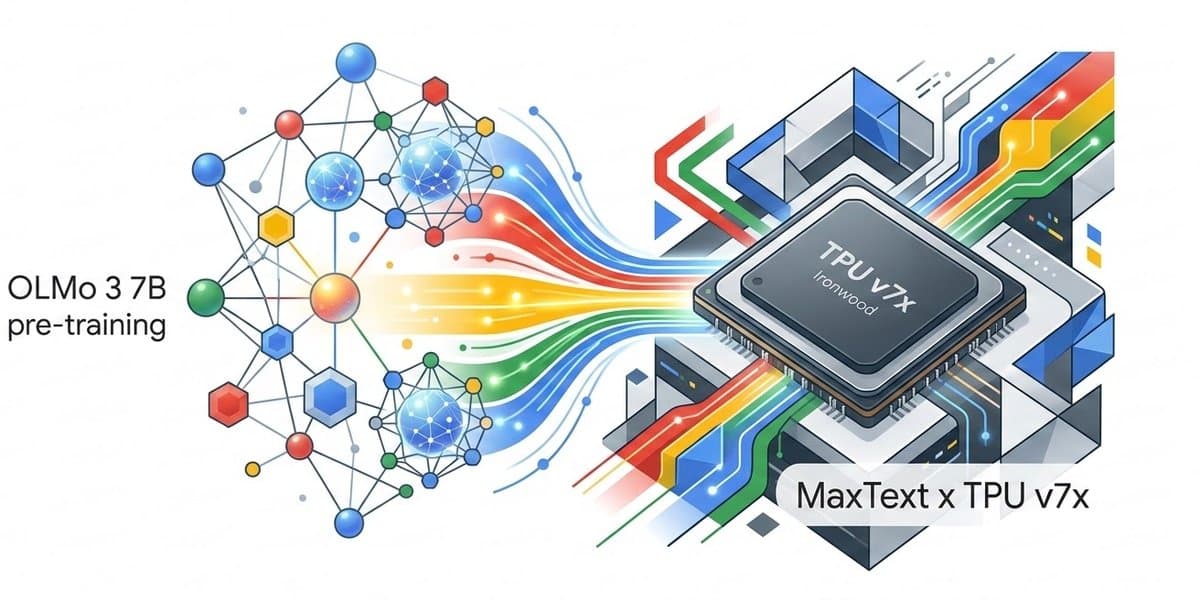
Reproducing OLMo 3 7B Pre-training in MaxText: A Case Study of Large-Scale Training on TPUs
以 MaxText 重現 OLMo 3 7B 預訓練:Google Cloud TPU 大規模訓練實戰指南
This case study details the successful reproduction of AI2's OLMo 3 7B pre-training and mid-training on Cloud TPUs using MaxText, detailing key performance tuning and debugging insights.