Building Communication-Efficient Social Intelligence in Language Agents with TACT
打造精鍊社交智能:TACT 框架如何讓 AI Agent 用最少 Token 達成談判目標
Socially intelligent agents often struggle to coordinate concisely. The TACT (Teacher-Assisted Communication Training) framework addresses this by revising student-generated actions through two specialized teachers: an expression specialist (which reduces wordiness) and a strategy specialist (which optimizes tactical moves). By simulating partner reactions, TACT selects teacher references that balance local goal support against action-token costs, distilling this efficient social intelligence back into the student model for independent deployment.
Key points
Dual dimensions of efficiency
Communication efficiency in agents spans both action strategy and expression, affecting not just the current utterance but also the partner's subsequent responses.
Dual specialist teachers
An expression specialist removes unnecessary detail while a strategy specialist proposes alternative actions to better address the partner's constraints.
Balancing goal and token cost
The framework samples partner responses to select the best teacher reference by actively balancing local goal support against action-token cost.
On-policy distillation
Guided on-policy distillation on student prefixes enables the student agent to act independently and efficiently during deployment.
How it works
Why it matters
In multi-agent and human-AI systems, wordy agents cause high computational latency, API costs, and user fatigue. TACT demonstrates that agents can achieve high social intelligence and better goal success with shorter, more strategic communication, charting a path toward highly resource-efficient and user-friendly AI assistants.
Who it affects
- AI Developer
- AI Researcher
- Product Manager
How to use it
- 1Automated business negotiations and multi-party resource coordination
- 2High-efficiency customer service bots and personal task assistants
Limitations & caveats
- Relies heavily on the quality of the simulated partner responses during the training and evaluation phases.
- The distillation process requires running multiple specialized teacher models, increasing training-phase complexity and compute overhead.
Related
The Agent Said It Was Done, the Database Disagreed: Introducing ThinkingBox
為什麼 Agent 的對話會騙人?微軟與 HF 推出 ThinkingBox 評測真實資料庫狀態
While traditional benchmarks only grade tool calls, ThinkingBox evaluates agents based on their actual terminal backend states and unintended side effects.
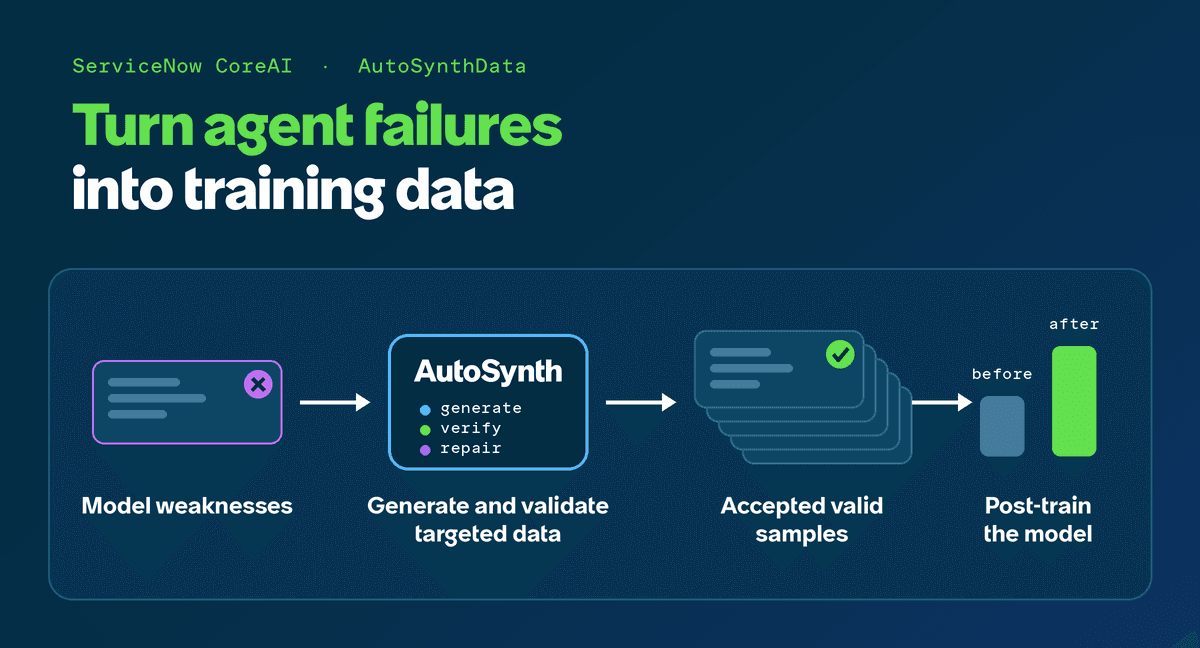
AutoSynthData: Generating Targeted Training Data from Enterprise Agent Failures
AutoSynthData:以企業 Agent 的失敗為師,自動生成高規格微調訓練資料
AutoSynthData is a framework by ServiceNow that analyzes an enterprise agent's failures against a stronger teacher to automatically generate and validate high-quality synthetic training data, bridging crucial performance gaps.
KaliBench: Evaluating and Boosting LLM Command Generation on Kali Linux
KaliBench:首個 Kali Linux 資安工具指令生成基準測試,助 8B 模型直逼 685B 巨獸
KaliBench is a fine-grained benchmark for evaluating LLM CLI command generation on Kali Linux. While open-weight models score below 42% accuracy, training an 8B model using KaliBench's runtime-free verifiable rewards allows it to rival a 685B MoE model.