Accelerating ROS 2 Nodes with AI Agents and NVIDIA Isaac ROS CUDA Buffers
使用 AI Agent 與 NVIDIA Isaac ROS 加速 ROS 2 節點:實現 GPU 零複製傳輸
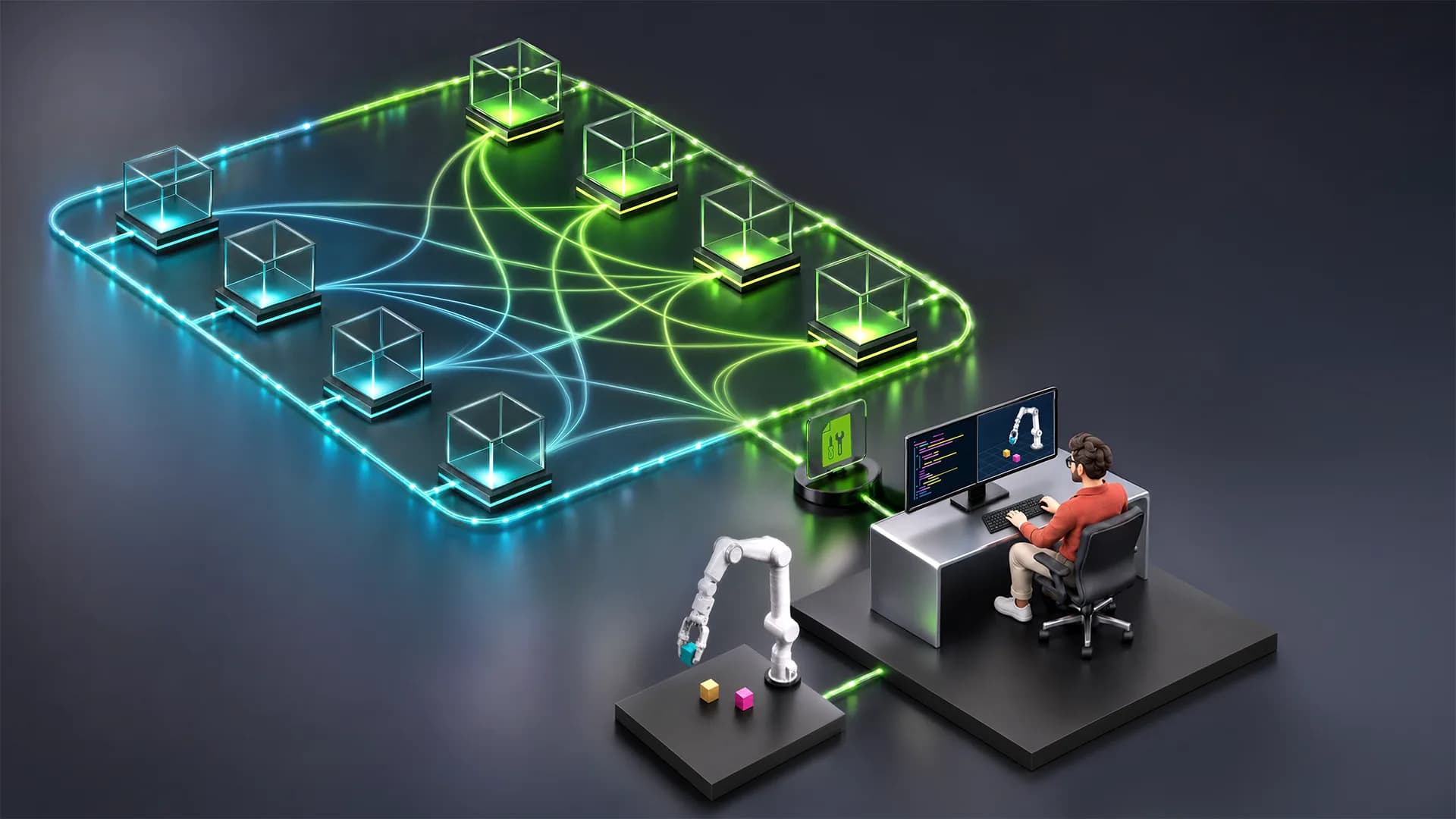
Even with fast GPU kernels, ROS 2 data transfer often suffers from CPU-memory copying and serialization bottlenecks. NVIDIA's CUDA buffer backend in ROS 2 Lyrical solves this by enabling co-located nodes to exchange GPU-resident data directly. To simplify migration, NVIDIA Isaac ROS 5.0 introduces an AI coding agent skill that automatically audits and refactors existing CUDA-accelerated nodes (such as Depth Anything v3) to leverage CUDA buffers with minimal code changes, while preserving automated CPU fallback.
Key points
Zero-Copy GPU Transport
By using ROS 2 Lyrical's rosidl::Buffer and the CUDA buffer backend, co-located GPU nodes can exchange data directly within GPU memory, bypassing CPU serialization.
AI-Driven Migration Skill
An AI coding agent uses the migrate-node-to-rosidl-buffer skill to automatically audit data flows, plan minimal interface-preserving patches, and update nodes.
Seamless CPU Fallback
If the runtime conditions or downstream nodes do not support CUDA buffers, the middleware automatically falls back to CPU-backed storage without needing dual code paths.
Hardware Optimized
The accelerated workloads are optimized for seamless deployment on NVIDIA Jetson AGX Thor, maximizing robotic perception and autonomy.
How it works
| 傳統路徑 (Traditional CPU Path) | CUDA 緩衝區路徑 (CUDA Buffer Path) | |
|---|---|---|
| Transport Mechanism | CPU 複製與序列化 (CPU serialization & copies) | GPU 虛擬記憶體零複製 (GPU VMM zero-copy) |
| Boundary Transitions | 主機與裝置間多次轉換 (H2D/D2H copies) | 完全保留在 GPU 記憶體 (Entirely GPU-resident) |
| Compatibility & Fallback | 標準通訊限制 | 自動且無縫退回 CPU 路徑 (Auto CPU fallback) |
Why it matters
Traditional ROS 2 communication introduces severe latency when passing large image or sensor data payloads due to CPU serialization and Host-to-Device/Device-to-Host (H2D/D2H) copies. By utilizing the CUDA buffer backend combined with AI-assisted migration, developers can effortlessly upgrade existing GPU-accelerated algorithms into an end-to-end GPU-resident pipeline. This dramatically reduces end-to-end communication latency and frees up critical CPU resources, which is crucial for real-time, multi-modal edge AI workloads running on autonomous mobile robots.
Who it affects
- AI Developer
- AI Researcher
- Product Manager
- Enterprise Leader
How to use it
- 1Low-latency image transfer between nodes in high-resolution robotic vision pipelines (e.g., Depth Anything v3 depth estimation).
- 2Real-time sensor fusion and obstacle avoidance for Autonomous Mobile Robots (AMRs) deployed on NVIDIA Jetson AGX Thor.
Limitations & caveats
- The optimized zero-copy CUDA transport path requires nodes to be co-located on the same host, CUDA device, Linux user, and use supported RMW implementations (e.g., Fast-DDS or Zenoh).
- It requires ROS 2 Lyrical or later, meaning older ROS 2 distributions cannot natively leverage the new rosidl::Buffer CUDA backend.
Related
AD-WM: Action-Discriminative World Models for Counterfactual MPC
AD-WM:專為反事實預測控制設計的動作辨識世界模型
AD-WM enhances latent world models by learning to distinguish alternative actions from the same state, significantly improving counterfactual control and zero-shot transfer in robotics.
RAPID: Robot Agentic Programming from Demonstrations
RAPID:只需單次視覺示範,AI 代理即可自動生成與優化機器人操控程式
RAPID is a framework that automatically infers task specifications and environments from a single visual demonstration, using an agentic loop to program and refine generalized robot skills.
Rolling-WAM: Accelerating Robotic World Action Models via Rolling Imagination
Rolling-WAM:利用滾動想像實現高效控制的機器人世界動作模型
Rolling-WAM accelerates world action models by distributing the joint video-action denoising process across sliding windows over successive replanning cycles, achieving a 4.5x speedup.