FleXray: Universal Generalist Model for Full-Body X-Ray Segmentation
FleXray:首款通用型全身體檢 X 光影像分割模型
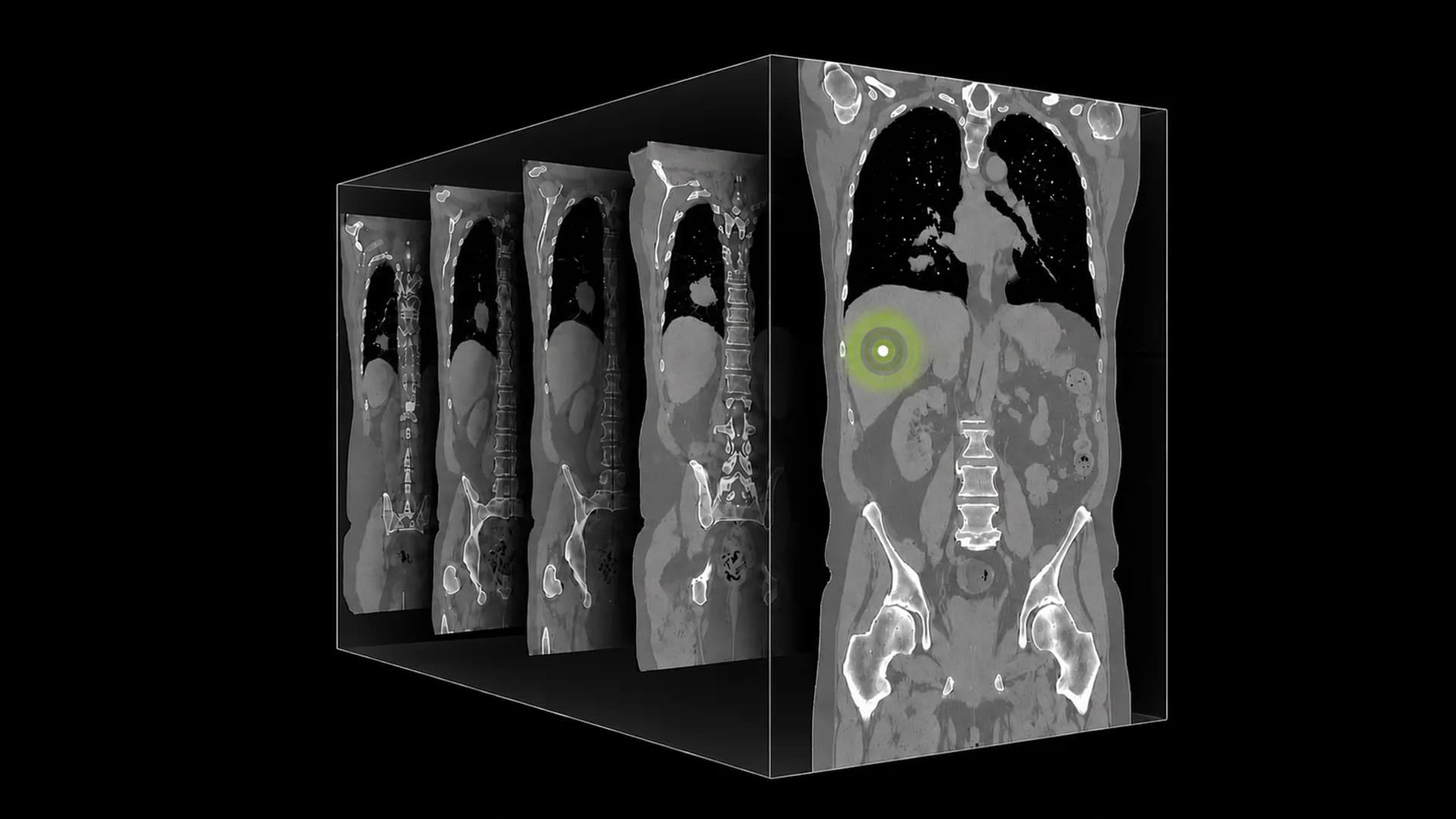
X-rays are widely used but hard to quantify because 3D anatomical structures overlap on a 2D projection, making manual labeling impractical. To solve this, researchers developed FleXray, a generalist model trained via a physics-based generative data engine. By projecting existing 3D whole-body CT datasets into annotated 2D X-rays and styling them with generative models, FleXray learns to segment 60 anatomical structures across unseen clinical X-rays, enabling automated disease grading and surgical navigation.
Key points
Physics-Based Data Engine
Leverages existing 3D whole-body CT datasets projected into 2D, combined with generative models for styling, bypassing the need for manual annotations.
60 Anatomical Structures
Breaks the limitation of narrow anatomical region models by segmenting up to 60 bones, organs, and structures across the entire body.
Open Model & Browser Tool
Releases the model, code, a complete dataset, and a local, user-friendly browser-based interface for broad accessibility.
How it works
Why it matters
X-rays are the most common medical scans but lack reliable quantitative tools due to the difficulty of manual segmentation. FleXray bypasses manual labeling bottlenecks by leveraging existing 3D CT data to train 2D X-ray models. This unlocks automated morphometric analysis, enabling low-cost, quantitative clinical assessments like disease grading and real-time guidance during minimally invasive surgeries globally.
Who it affects
- AI Researcher
- AI Developer
- Enterprise Leader
How to use it
- 1Automated clinical measurements and disease grading (e.g., cardiomegaly, joint space narrowing)
- 2Real-time anatomical navigation during X-ray-guided clinical interventions
- 3Data-efficient learning and downstream fine-tuning for specific pathological targets
Limitations & caveats
- Sim-to-real gap: Simulated generative X-rays might still slightly differ from highly complex real-world pathologies or rare implants.
- Extreme overlaps: Highly ambiguous anatomical boundaries under extreme projection angles may still test segmentation limits.
Related
PoEM: Predicting RL Outcomes Without Re-training Existing Policies
不需重新訓練!PoEM 演算法直接預測新獎勵函數的強化學習結果
The PoEM framework enables researchers to accurately predict and synthesize new RL policies without any actual RL training, by leveraging linear combinations of existing post-trained models in log-space.
NVIDIA Introduces NV-Reason-CT: Open 3D CT VLM with Radiologist Chain-of-Thought Reasoning
NVIDIA 推出首款開源 3D CT 醫療視覺語言模型 NV-Reason-CT,導入放射科醫師思考鏈推論
NVIDIA introduces NV-Reason-CT, an open 3D CT vision-language model that combines a native 3D ViT with a Qwen LLM to emulate radiologist chain-of-thought reasoning and generate structured reports.
Who Said What to Whom? SpeakerMem-R1 Introduces Dual-Track Memory for Multi-Party Dialogues
「誰對誰說了什麼?」SpeakerMem-R1 打造多方對話專屬的雙軌記憶機制
SpeakerMem-R1 tackles multi-party dialogue memory challenges using a speaker-labeled dual-track system and GRPO training to improve message attribution and social relation tracking.