NVIDIA VSS Blueprint 3.3: Lowering Visual AI Agent Costs with Smart Sampling and Agent Skills
NVIDIA VSS Blueprint 3.3 登場:以智慧採樣與 AI 代理技能,大幅降低視覺 AI 部署成本
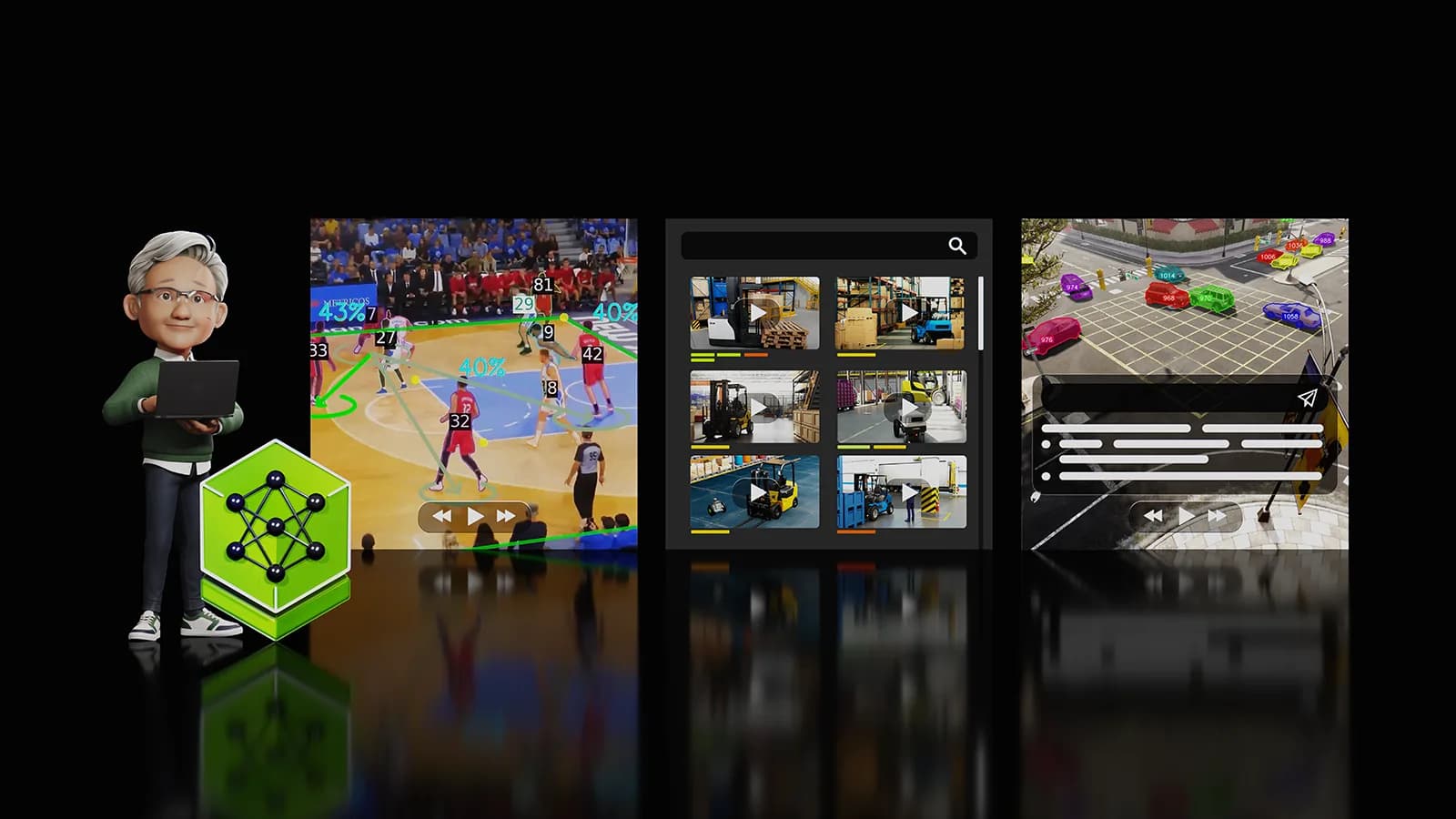
NVIDIA VSS Blueprint 3.3 targets development and runtime bottlenecks of visual AI agents. It introduces the vss-build-vision-ai skill to compose multi-workflow applications from a single prompt in under 30 minutes. For runtime efficiency, its new Adaptive Efficient Video Sampling (EVS) dynamically prunes redundant visual tokens of static background patches, resulting in 80% fewer VLM input tokens for summarization and a 46% increase in concurrent video streams on the same GPU.
Key points
Prompt-Based Composition
Using the vss-build-vision-ai skill, developers can design, generate, and deploy complex video agent stacks in under 30 minutes with a single prompt.
Infrastructure Reuse
Leverages four validated profiles as templates, dynamically calculating the smallest delta to reuse existing infrastructure and avoid service duplication.
Adaptive EVS
Uses cosine similarity to dynamically prune static frame patches and batch active segments, drastically lowering compute load on vision-language models.
Drastic Efficiency Gains
Saves 80% of summarization tokens, cuts alert latency by 17%, and increases concurrent streams on a single GPU by 46% (from 13 to 19 streams).
How it works
| 標準處理 (Standard) | 自適應採樣 (Adaptive EVS) | |
|---|---|---|
| 60-Min Summary Tokens | 100% (基準) | 減少 80% (僅需 20% Token) |
| Max Concurrent Streams | 13 路串流 | 19 路串流 (+46%) |
| Alert Latency | 1,021 毫秒 | 844 毫秒 (加快 17%) |
Why it matters
Scaling visual AI agents in production is blocked by high token costs and complex pipelines. VSS 3.3 tackles both: Adaptive EVS slashes visual token overhead, while automated orchestration eliminates duplicate infrastructure. This significantly lowers Total Cost of Ownership (TCO) and time-to-market, unlocking viable large-scale deployments for smart cities and industrial automation.
Who it affects
- AI Developer
- Product Manager
- Enterprise Leader
How to use it
- 1Bottling Line Overflow Detection: Monitor filler cameras, trigger real-time alerts for spills, verify alerts via VLM to reduce false positives, and generate shift summary reports.
- 2Smart City Traffic Management: Track vehicles, detect collisions, trigger validated alerts, and allow operators to query historical footage using natural language.
Limitations & caveats
- The efficiency of Adaptive EVS depends heavily on scene motion, chunk length, and similarity thresholds; highly dynamic scenes will yield lower savings.
- Runs locally within the RT-VLM container rather than remote API endpoints, and extreme pruning could potentially discard minor but critical spatial details.
Related
PDMD: Stabilizing Video Diffusion Distillation via Projected Distribution Matching
PDMD:投影分佈匹配蒸餾技術,解決影片擴散模型的一步生成偽影
PDMD stabilizes video diffusion distillation by projecting out critic errors using the student-critic endpoint residual, achieving high-quality 4-step generation with a one-line code change.