Simplifying Multi-GPU Serving: NVIDIA Dynamo-Triton Integrates TensorRT Multi-Device Inference
簡化多 GPU 模型部署:NVIDIA Dynamo-Triton 推出 TensorRT 多裝置整合技術
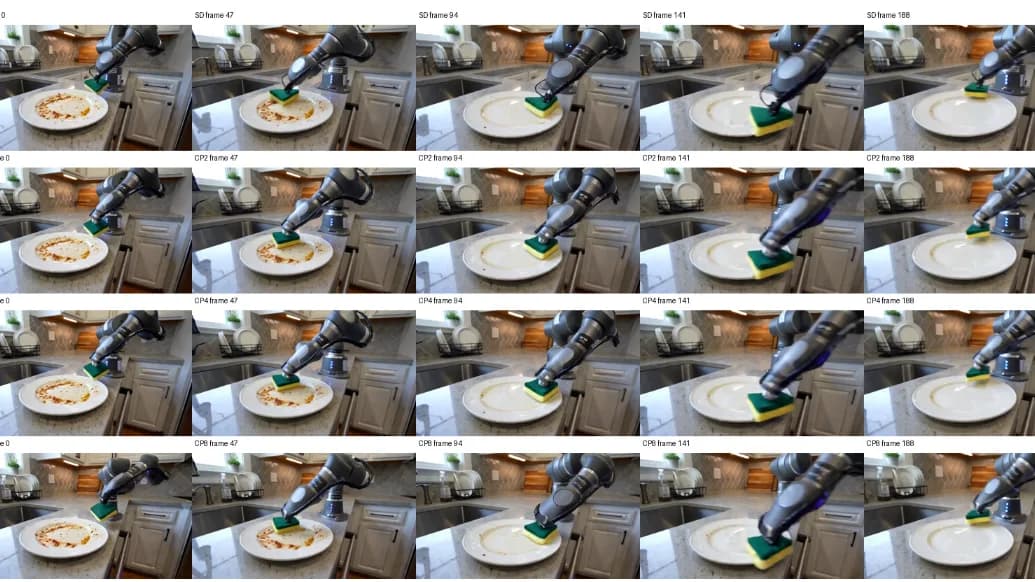
As generative AI exceeds single-GPU capacities, NVIDIA introduces TensorRT multi-device inference. Supported in Dynamo-Triton 26.07, a single Triton model instance can now manage multiple GPUs and NCCL communicators. Using the Cosmos 3 Nano video generation model as a benchmark, scaling to 8 GPUs reduced end-to-end latency from 156.6 seconds to 34.2 seconds, achieving a 6.09x Transformer RPC speedup while completely removing client-side multi-GPU coordination.
Key points
Unified gRPC Endpoint
Clients query a single named model through a gRPC endpoint while Triton handles GPU ranks and NCCL communication, removing rank-coordination code from the client.
Ulysses Context Parallelism
The compiled TensorRT plan embeds Ulysses context parallelism, partitioning the sequence axis around attention layers to distribute massive token sequences across GPUs.
Dramatic Latency Reduction
Scaling Cosmos 3 Nano to 8 GPUs slashed generation time from 156.6s to 34.2s, accelerating iteration loops for latency-sensitive media workflows.
Optimized Collective Operations
Torch-TensorRT compiles PyTorch operators into TensorRT's distributed-collective layers (reduce-scatter, all-to-all, all-gather) to maximize hardware communications.
How it works
| SD (1 GPU) | CP2 (2 GPUs) | CP4 (4 GPUs) | CP8 (8 GPUs) | |
|---|---|---|---|---|
| E2E Mean Latency (s) | 156.595 | 87.999 | 53.093 | 34.183 |
| E2E Speedup | 1.00x | 1.78x | 2.95x | 4.58x |
| RPC Mean Latency (s) | 146.192 | 77.548 | 42.661 | 23.993 |
| RPC Speedup | 1.00x | 1.89x | 3.43x | 6.09x |
| RPC Share | 93.4% | 88.1% | 80.4% | 70.2% |
Why it matters
For enterprises deploying generative AI, this closes the gap between raw multi-GPU performance and consumable web services. Teams can trade GPU resources for lower latency without changing their application interface or surrounding workflows, bypassing the need to maintain distributed rank-lifecycle code in the client.
Who it affects
- AI Developer
- AI Researcher
- Product Manager
- Enterprise Leader
How to use it
- 1Accelerating inference for heavy video generation models like Cosmos 3 Nano using multi-GPU clustering.
- 2Serving long-context Transformer models over low-latency gRPC endpoints.
- 3Packaging complex, distributed TensorRT engine plans into versioned Triton model repositories.
Limitations & caveats
- Distributed multi-GPU inference outputs are not pixel-identical to single-GPU baselines (CP8 measured MAE of 16.316, though within acceptable quality thresholds).
- The benchmark does not measure concurrent request throughput, cost per generated video, or total cost of ownership (TCO).
Related
NVIDIA Expands AI Storage Acceleration with cuObject and SCADA Server SDK
NVIDIA 推出 cuObject 與 SCADA 伺服器 SDK:實現免經 CPU 的 GPU 直連快取與物件儲存加速
NVIDIA announced the general availability of cuObject libraries and the new SCADA Server SDK, enabling GPU-initiated, zero-copy storage access over RDMA to bypass the CPU and accelerate AI workloads.
Unlocking Stranded Capacity: How NVIDIA DSX MaxLPS Boosts AI Factory Throughput by 49%
破解電力瓶頸:NVIDIA DSX MaxLPS 如何釋放 AI 工廠高達 40% 的隱形算力
A joint NVIDIA and Nscale evaluation demonstrates that DSX MaxLPS dynamically allocates power to deploy 37% more GPUs and boost LLM throughput by 49% within the same power budget.

NVIDIA Launches Open-Source NVCRE: Automating GPU Cluster Readiness Validation Before AI Workloads Run
NVIDIA 開源 NVCRE:在 AI 工作負載上線前,自動驗證 GPU 叢集準備狀態
Traditional GPU health checks often miss performance bottlenecks in distributed training. NVIDIA's open-source NVCRE is a Kubernetes controller that runs active, topology-aware workloads to pinpoint failing nodes before production starts.