The Machines That Make the Machines: How NVIDIA Automates GB300 Tester Tray Assembly
機器造機器:NVIDIA 如何用 AI 與實體控制自動組裝 GB300 測試托盤
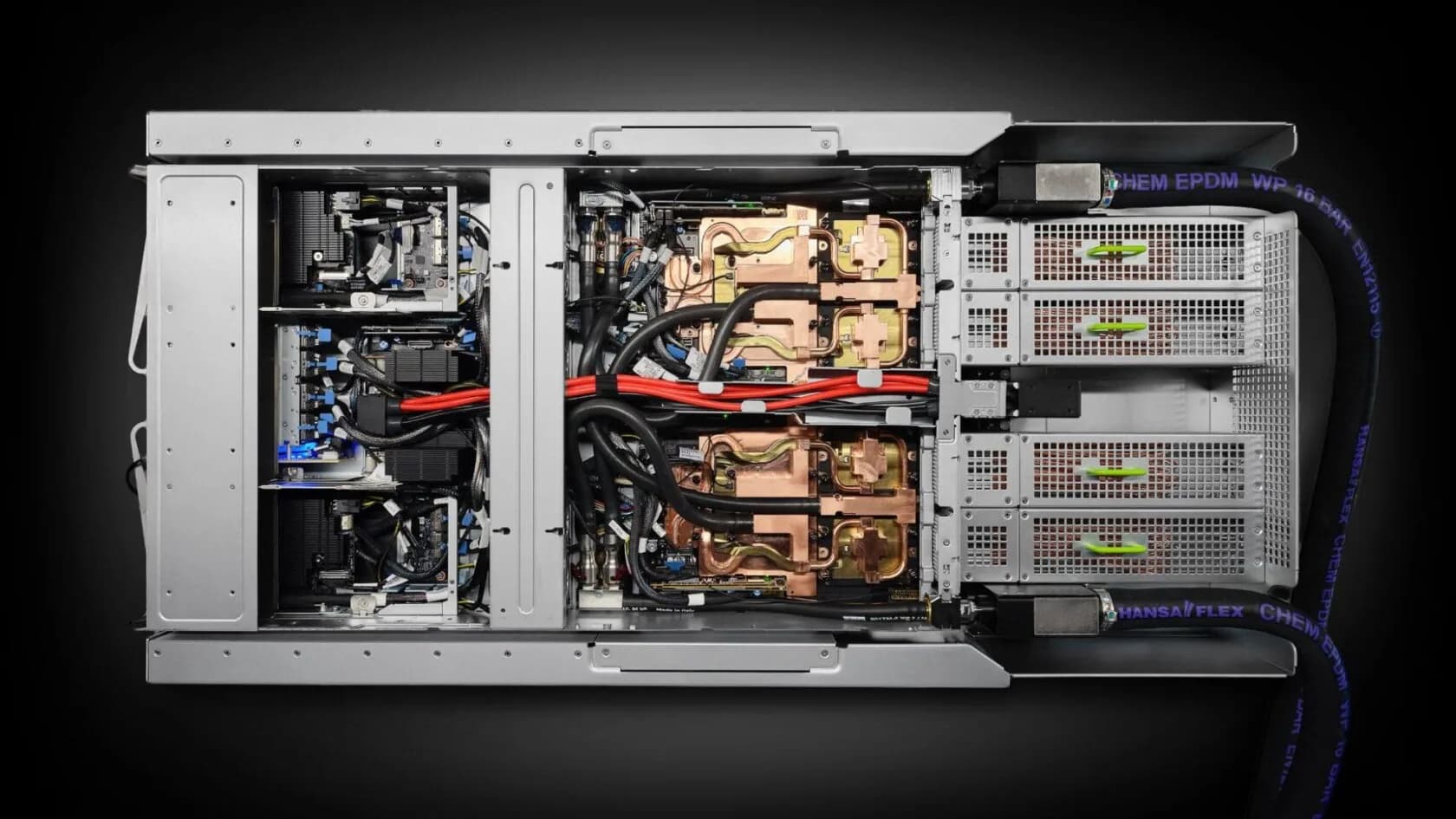
NVIDIA Seattle Robotics Lab and the Isaac team tackled automating GB300 tester tray assembly. Focusing on busbar assembly and multi-connector insertion, they overcame deformable cables and tight clearance sockets. Rather than relying solely on end-to-end learning, they combined a classical control pipeline with DOPER pose estimation, custom 3D-printed gripper fingers, and real-world reinforcement learning (via SPARR). Achieving 90-95% success rates, they demonstrated how hybrid systems bridge the gap toward industrial-grade standards.
Key points
Flexible Automation over Rigid Fixtures
Rapid hardware design cycles make rigid, fixed fixtures impractical; robots must adapt dynamically to part variations and deformable cables.
The Inverse Bitter Lesson
When physical interaction data is scarce and components wear out, scaling data is intractable; structured engineering and sample-efficient models are crucial.
Mechanical Design Defeats Software Complexity
Custom 3D-printed gripper fingers use physical geometry to constrain parts, eliminating the need for complex tactile sensing or in-hand manipulation.
Sim-to-Real Boosted by Real-World Data
While insertion policies were pretrained in Isaac Lab, achieving industrial precision required real-world residual RL (SPARR) using force-torque feedback.
How it works
| 匯流排組裝 (Busbar) | 多接頭插拔 (Multi-connector) | |
|---|---|---|
| Target Success Rate | 99.5% | 99.5% |
| Target Cycle Time | 124 秒內 | 72 秒內 |
| Perception Approach | 多視角 FoundationPose 與 DOPER 估計 6D 位姿 | SAM3 分割線材 + DOPER 預測無紋理接頭位姿 |
| Control & Learning Strategy | 經典軌跡規劃器 + 高性能阻抗控制器 | 模擬器 Isaac Lab 預訓練 RL + 實體力矩殘差 RL (SPARR) |
| Current Performance | 成功率 >95% (瓶頸在螺絲起子耗時) | 成功率 90-95% (瓶頸在接頭微調速度) |
Why it matters
Automating hardware assembly addresses critical manufacturing labor shortages (with 1.9M jobs projected unfilled by 2033). Long-term, it bootstraps a virtuous cycle: AI-powered robots assemble advanced AI hardware, which in turn trains the next generation of AI and robotic agents.
Who it affects
- AI Developer
- AI Researcher
- Enterprise Leader
How to use it
- 1Automated assembly and insertion of high-precision electronic components and deformable cables.
- 2Real-time 6D pose estimation of textureless industrial parts using DOPER.
- 3Multi-arm coordination and force control on heterogeneous robot arms using the TALOS framework.
Limitations & caveats
- While success rates reached 90-95%, they still fall short of the strict 99.5% factory standard, and cycle times still exceed twice human speed.
- Current physics simulators still struggle to accurately model geometrically irregular and highly non-linear deformable cables.
Related
QF3: Fast Flow RL with Filtered Q-Gradients
QF3:利用過濾 Q 梯度實現快速流匹配強化學習的機器人控制技術
QF3 is an off-policy RL algorithm that accelerates flow-based policy training with a 10x speedup, enabling humanoid locomotion training from scratch and successful zero-shot hardware transfer.
DepthWorld: 3D World Model for Robot Manipulation
DepthWorld:為機器人操控打造的 3D 世界模型
To resolve the 3D inconsistency of current video world models, DepthWorld jointly predicts multi-view RGB and metric depth, significantly improving geometric accuracy for robotic planning.
VeriFine: Scaling Verification for Self-Improvement in Embodied Reasoning
VeriFine:透過協同演化驗證機制實現具身智慧的自我迭代
VeriFine is an agent framework for embodied reasoning that co-evolves the policy and its verification judge through dual loops, overcoming the optimization bottlenecks of static evaluation.