5 Steps to Build SimReady Robotics Assets with Frontier AI Models
5 步驟建構 SimReady 機器人資產:結合前沿 AI 模型與 NVIDIA Omniverse
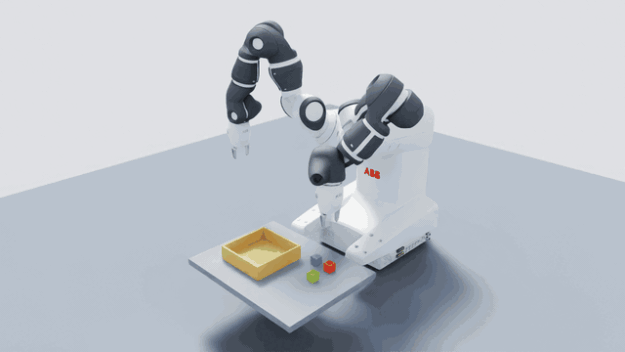
Preparing CAD files for physics-accurate robotics simulation requires configuring complex joint and material behaviors. NVIDIA details a structured 5-step workflow using frontier AI models like GPT-6 Astra as reasoning agents. By calling Omniverse APIs via specialized skills, the agent automates CAD-to-USD conversion, visual alignment, physical property configuration, SimReady validation, and final pick-and-place simulation in Isaac Sim, significantly reducing manual effort.
Key points
STEP-to-USD Conversion
Converts source STEP files into OpenUSD format to establish a unified base for visual and physical simulation assets.
Frontier AI-Guided Setup
Employs models like GPT-6 Astra to call Omniverse APIs and write scripts for material and physics assignments.
Intelligent Physics Estimation
When spec sheets lack data, the AI references public URDFs or estimates mass, inertia, and joint limits using CAD geometry.
Automated SimReady Checks
Uses validation engines to check units, joint drives, and dependencies against standard SimReady Foundation rules.
How it works
- Step 1STEP Conversion
Import CAD STEP files and convert them to OpenUSD format using Omniverse tools guided by AI.
- Step 2Appearance Validation
Compare against reference images and videos to adjust colors, metallic values, and roughness.
- Step 3Physics Configuration
Define rigid bodies, joint limits, masses, and approximate collision shapes.
- Step 4SimReady Validation
Run automated checks to verify units, assets, joint drives, and mass tensors against standards.
- Step 5Simulation Task
Run full physical pick-and-place task cycles in Isaac Sim to verify real-world behavior.
Why it matters
Translating raw CAD data into physics-accurate virtual robot assets has historically required tedious manual tuning. By coupling frontier AI reasoning with NVIDIA Omniverse automation tools, developers can significantly accelerate the asset-preparation pipeline, generating high-fidelity, standardized SimReady assets crucial for scaling embodied AI training.
Who it affects
- AI Developer
- AI Researcher
- Enterprise Leader
How to use it
- 1Accelerated conversion and deployment of industrial robot CAD files (like ABB YuMi) to virtual environments.
- 2Validating robot joints, drive behaviors, and grip stability under physical simulation for automation tasks.
Limitations & caveats
- Key physical parameters (such as friction coefficients) are simplified approximations and not calibrated against actual physical robots.
- The overall workflow success and code generation quality remain dependent on the chosen frontier AI model and prompt inputs.
Related
The Machines That Make the Machines: How NVIDIA Automates GB300 Tester Tray Assembly
機器造機器:NVIDIA 如何用 AI 與實體控制自動組裝 GB300 測試托盤
NVIDIA Seattle Robotics Lab shares insights from automating GB300 superchip tester tray assembly, highlighting the synergy between classical control engineering, smart mechanical design, and RL.
Long-WAM: Scaling Context for Real-Time World-Action Models
Long-WAM:突破即時控制延遲,擴展機器人世界動作模型的長上下文
Long-WAM scales the visual history context of world-action models under real-time constraints, demonstrating that autoregressive pretraining is key to unlocking the power of long video memories.
"Rephrase Before You Act": Mitigating the Extreme Language Sensitivity of Vision-Language-Action Models
機器人控制的「文字敏感症」:為何一個詞能讓 VLA 模型成功率從 100% 跌到 2%?
This study exposes the extreme sensitivity of Vision-Language-Action (VLA) models to instruction phrasing and introduces a zero-shot framework that uses LLMs to distill rewriting rules, significantly boosting robotic task success without retraining.