AI Daily ·
Robotics & World Models Breakthroughs: From End-to-End Humanoid Locomotion to 3D Spatial Understanding
今日 AI 重點
Today's AI breakthroughs highlight major advancements in robotics and world models. Notably, the QF3 algorithm accelerates flow-based policy training by 10x, enabling humanoid locomotion training and zero-shot hardware transfer. Meanwhile, DepthWorld jointly predicts multi-view RGB and metric depth to significantly improve geometric accuracy for robotic planning. Additionally, Google launched EmbeddingGemma 2, a compact 740M parameter multimodal embedding model designed to bring ultra-low latency, on-device vectorization to edge AI applications.
- 01arXivRobotics
QF3: Fast Flow RL with Filtered Q-Gradients
QF3 addresses the slow training speeds of flow-based robot policies in RL. By combining flow matching with critic action gradients backpropagated through a one-step prediction, and filtering gradients to reliable action dimensions, QF3 achieves a 10x speedup over FPO++. It is the first off-policy flow RL method capable of training humanoid locomotion from scratch and transferring it zero-shot to real hardware.
- 02arXivRobotics
DepthWorld: 3D World Model for Robot Manipulation
Traditional video-based world models rely only on RGB, producing realistic frames that lack 3D geometric consistency. To solve this, researchers introduced a calibration pipeline to upgrade the DROID dataset into DROID-3D, containing dense metric depth and precise extrinsics. They trained DepthWorld (based on Stable Video Diffusion) using spatial latent tiling to jointly predict multi-view RGB and depth, boosting RGB prediction by +1.48 dB PSNR while providing accurate depth for robotic reasoning.
- 03arXivAI Research
Sherpa Framework: Training LLMs to Teach Adaptively via Reinforcement Learning
Traditional AI tutoring models struggle with adaptive instruction because they rely on static guidelines. To address this, researchers developed Sherpa, a multi-turn reinforcement learning framework. Sherpa instantiates simulated student LLMs with diverse learning preferences and trains the teacher LLM by directly rewarding improvements in student test performance. The trained teacher improved student scores by an average of 20.5 percentage points, boosted its MathTutorBench pedagogy score from 52.5% to 79.2%, and achieved a 79.6% human preference rate over the base model.
- 04arXivAI Agent
AdvSim2Real: Co-Evolving Web Agents and Adversaries inside a Web World Model
Web agents are highly vulnerable to prompt injections planted on third-party pages. AdvSim2Real solves this by co-evolving a task curriculum, an injection adversary, and the web agent itself within a frozen web world model. The adversary is rewarded for triggering "success flips" (turning success to failure), while the curriculum dynamically adjusts task difficulty. This approach significantly enhances both general task completion and robustness, achieving a 33.6% relative improvement under unseen frontier-model attacks when transferred to a real browser.
- 05arXivRobotics
VeriFine: Scaling Verification for Self-Improvement in Embodied Reasoning
Traditional self-improvement is limited by static judges that cannot adapt as policies evolve and expose new failure patterns. VeriFine solves this with a dual-loop framework. The Policy Improvement Loop uses a rubric judge to diagnose failures, select data, and optimize policies via adaptive curricula. When improvement plateaus, the Judge Improvement Loop engages human guidance on informative edge cases to refine the judge via coactive calibration. Experiments on driving and robotic navigation prove its effectiveness in enabling continuous co-evolution.
- 06arXivAudio AI
WorldSonus: Bringing Real-Time Spatial Audio to World Models
While current world models excel at visual synthesis, they usually remain silent. WorldSonus addresses this gap by tackling real-time streaming, dynamic control, and spatial alignment. It features a streaming causal autoregressive diffusion architecture with a low real-time factor (RTF) of 0.41. Using chunk-indexed prompt scheduling, users can control sound events mid-stream. Additionally, training with stereo and ambisonic datasets ensures synthesized audio aligns perfectly with camera and scene dynamics.
 07Google AI DevelopersLLM
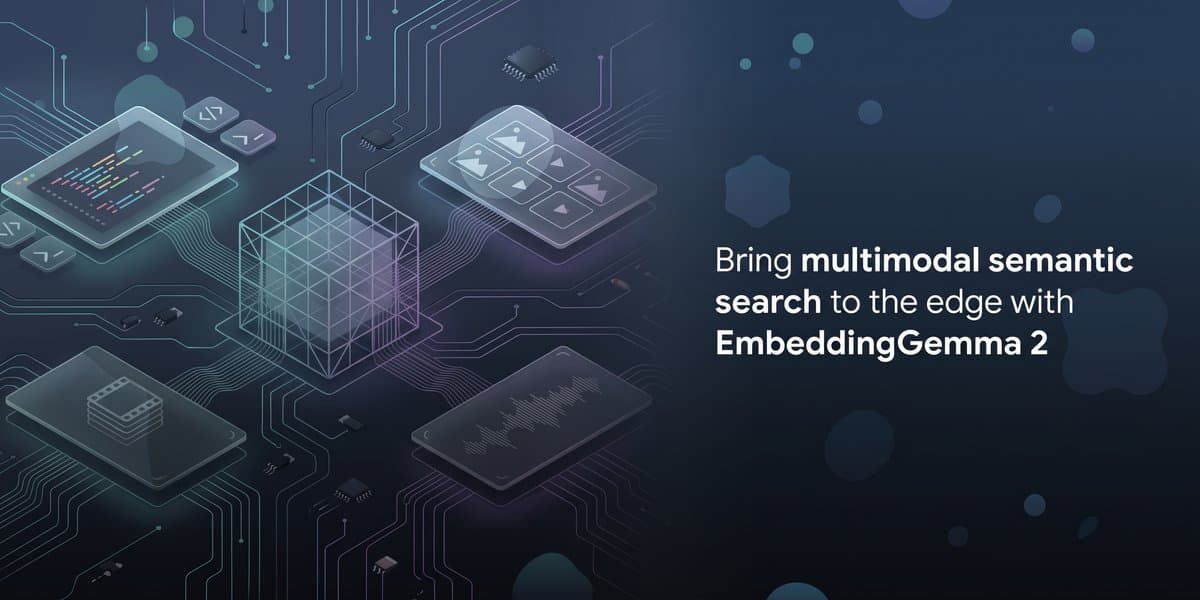
Google Launches EmbeddingGemma 2: Compact 740M Parameter Multimodal Embedding Model for Ultra-Low Latency Edge AI
Google DeepMind has launched EmbeddingGemma 2, a 740M parameter open-weight multimodal embedding model. Designed for privacy-first, on-device operations, it natively maps text, images, video, and audio into a single vector space. Running on as little as 567MB active RAM on a Pixel 11 Pro, it replaces complex model chains with a single, efficient engine. Developers can deploy it via LiteRT, MediaPipe, or ML Kit to enable real-time semantic search, visual retrieval, and <100ms on-device decision routing without fine-tuning.
- 08arXivLLM
Towards Looped Models Done Right: Rethinking at Fixed Points for Efficient Training, Decoding, and RL
Looped language models incur high costs per recurrence. This study leverages the insight that as recurrent states approach fixed points, the exact path taken matters less. To exploit this, the authors introduce a learned depth prior (via prediction feedback with entropy regularization) and orthogonal input injection. Tested across 100M to 1.6B parameters, these techniques consistently lower perplexity. They enable 3x smaller KV cache via terminal sharing, 1.79x faster student prefill, and 2x faster RL gradient computation directly from saved rollout states.
- 09arXivAI Agent
CLIFT: Conformal Self-Verification for Web Agent Training and Test-Time Scaling
Training open-source web agents suffers from sparse binary rewards, while using frontier LLMs as step-by-step judges is too expensive and unavailable at deployment. CLIFT solves this via conformal self-verification. During training, the agent answers verification questions about its actions, filtered by a conformal certifier to guide reward design. At test time, this frozen verification bank enables Conformal Trajectory Selection (CTS) across multiple rollouts, achieving judge-free test-time scaling.
 10NVIDIA DeveloperRobotics
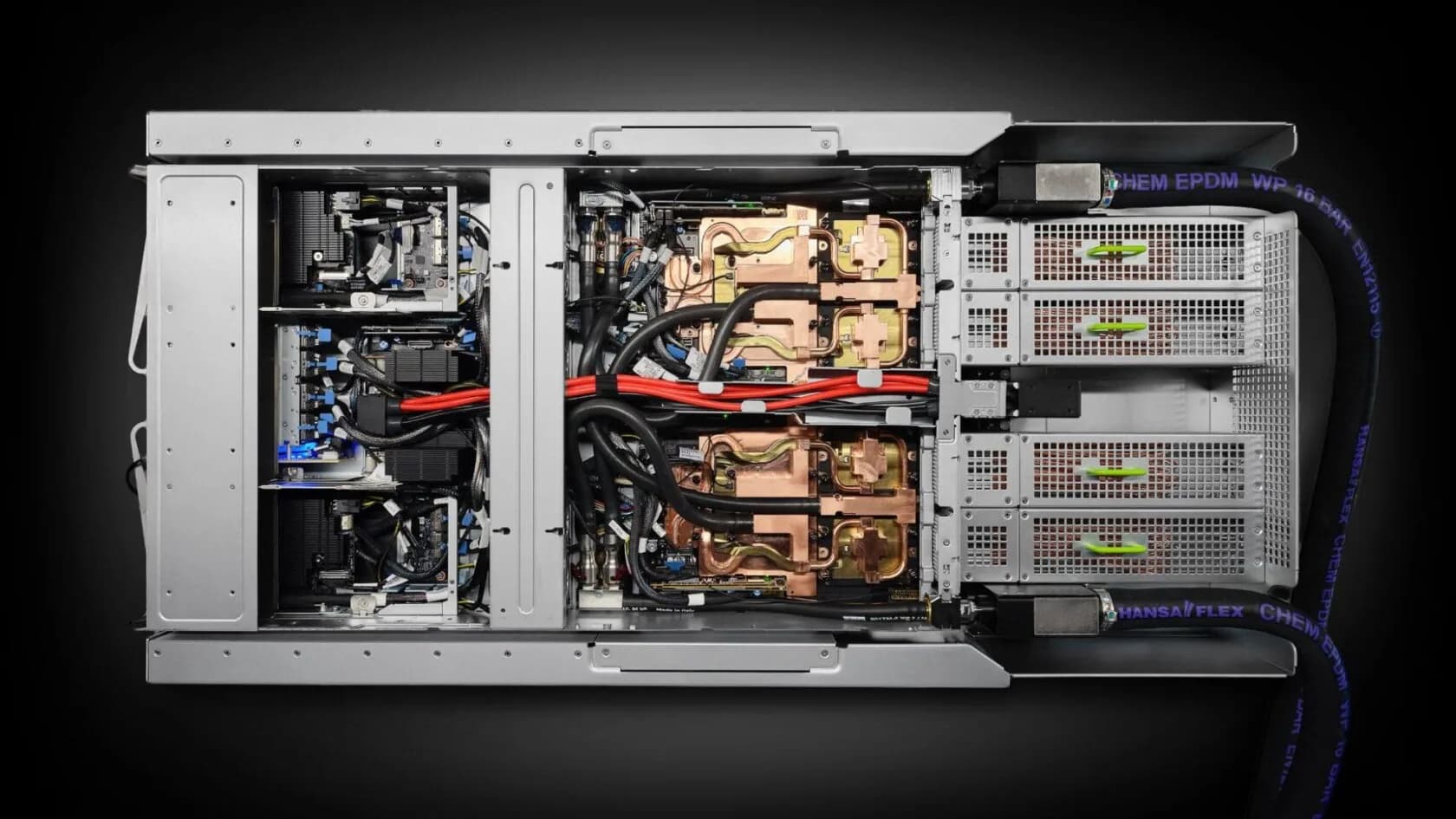
The Machines That Make the Machines: How NVIDIA Automates GB300 Tester Tray Assembly
NVIDIA Seattle Robotics Lab and the Isaac team tackled automating GB300 tester tray assembly. Focusing on busbar assembly and multi-connector insertion, they overcame deformable cables and tight clearance sockets. Rather than relying solely on end-to-end learning, they combined a classical control pipeline with DOPER pose estimation, custom 3D-printed gripper fingers, and real-world reinforcement learning (via SPARR). Achieving 90-95% success rates, they demonstrated how hybrid systems bridge the gap toward industrial-grade standards.